Sunday, August 4, 2013

The Common Milkweed: Butterflies & The Importance of Going Natural

As I mentioned in another entry previously, we decided to leave areas of our property not mowed so that we could see what grows naturally and its effect on local wildlife. So many "weeds" are quite beneficial and beautiful with flower displays. .

We want to keep our designated areas as natural as possible, identify those plants that seem beneficial, and then add other good sources of food and shelter as we need to, in order to "beautify" and expand the resources for our beloved animals. It's going to be a long process but I am glad we are starting this early so we can gradually attain our final goal of our own private wildlife preserve.

An area by our cess-pond (as I fondly call it) was mowed last year since the entire property was seriously overgrown (the previous owners used it only occasionally as a vacation home), but this year with David leaving it among our "test areas" we recently saw about 30 butterflies of different species engulfing plants with pinkish flowers, a Common Milkweed (Asclepias syriaca).

This native perennial plant is 2 - 6 feet tall (typically 3 - 4 feet tall) and unbranched, except sometimes toward the apex, where the flowers occur. The central stem is relatively stout, pale green, cylindrical and slightly tapered. The opposite leaves are up to 8" long and 3½" wide, broadly oblong in shape, and smooth along their margins. The upper leaf surface is pale-medium to dark green and hairless above, while the lower leaf surface is densely covered with woolly hairs that are very short. There is a prominent central vein along the length of each leaf, and finer side veins that radiate outward toward the smooth margins.

Umbels of flowers, each about 2½" - 4" across, emerge from the axils of the upper leaves. These flowers are quite fragrant, with a scent resembling violets or pansies, and they range in color from faded light pink to reddish purple. Each flower is about ¼" across, star-shaped in dense rounded clusters at top of straight stem. The hoods are more light-colored than the petals. The pedicels of the flowers are light green to pale red and hairy. The blooming period lasts about 1 - 1½ months from early to mid-summer (June, July, August). The seedpods (follicles) are 3" - 4" long and covered with soft prickles and short woolly hairs. At maturity, each seedpod split along one side to release numerous seeds that have large tufts of white hair, with dispersion of seed by wind. The root system has long creeping rhizomes, promoting the vegetative spread.

Common Milkweed occurs in every county of Illinois and it is quite common. Habitats include moist to dry black soil prairies, sand prairies, sand dunes along lake shores, thickets, woodland borders, fields and pastures, abandoned fields, vacant lots, fence rows, and areas along railroads and roadsides. This plant is a colonizer of disturbed areas in both natural and developed habitats.

The crown-like flowers of milkweeds are cunning traps for insect pollinators, second in their intricacy only to the orchids. Each blossom has five nectar cups with smooth, incurved horns growing from them. When an insect lands, its foot slips on a horn and goes into a slit between two cups. If the insect is not strong enough to pull its legs out, it dies there (or is eaten by another). If it is strong enough, it comes away carrying two bags of pollen, called pollinia, like saddlebags. At the next flower, its foot slips again; this time, as it picks up more pollinia, it deposits the first two beside the cups, where the pollen develops to fertilize future seeds.

When either the central stem or leaves are torn, a milky sap oozes out that has variable toxicity in the form of cardiac glycosides. The name milkweed refers to the milky white  sap, which contains bitter chemicals to protect the plants from predators. A few insects are immune to these poisons and accumulate them in their bodies, protecting themselves from their own predators. Monarch butterflies cannot complete their life cycles without milkweed. 

There is a legend of the Old West about a runty outlaw who drank rattlesnake venom every morning so he could kill a big man by spitting in his eye. Milkweeds furnish similar venom for Monarch butterflies. The leaves are poisonous to most animals, but Monarch caterpillars and a few others eat nothing else. As a result, they - and the butterflies they become - are themselves toxic to potential predators. The Viceroy butterfly benefits by its resemblance to the Monarch; predators tend to leave them alone. This is known as mimicry and is also true for other species as well, such as the Pipevine Swallowtail.
 
~~~~~~~~~~~~~~~~~~~~~~~~~~~~~~~~~~~~~~~~~~~~~~~~~~~~~~
And believe it or not, the milkweed can be used as food for human consumption, but please first note: Warning: ***Poisonous Parts***: Milky sap from leaves, stems (toxic only in large quantities). Symptoms include vomiting, stupor, weakness, spasms by ingesting other species; need careful identification.   

Edible Parts:  Leaves, new shoots, flower buds and firm seed pods. Gather leaves in early spring when they first open. Gather seed pods in summer. Parboil for three minutes, then discard bitter water and replace with clean boiling water. (Cold water tends to fix bitterness.) Repeat this process three times, then cook the leaves for 15 minutes before seasoning them. A pinch of soda can be added during cooking to break down the fiber and improve flavor.

The young shoots under six inches long, found during the spring are used as a vegetable. Remove the fuzz on the shoot by rubbing it off. Preparation is the same as for the leaves. Collect flower buds and flowers during the summer. Dip buds in boiling water for one minute, batter and deep fry. When cooked like broccoli, buds are similar to okra. The flower clusters may also be battered and fried. After cooking, buds, flowers and leaves can be frozen. Use like okra in soups. A bit of baking soda in the water will help break down the tough fibers in the seed pod. Parboiled for several minutes, the young pods may be slit, rolled in a cornmeal/flour mixture and fried or frozen for future use.
~~~~~~~~~~~~~~~~~~~~~~~~~~~~~~~~~~~~~~~~~~~~~~~~~~~~~
 
Whether it's as a food source, shelter, or as a balance with other plant life, so much of our wildlife depends on them! When I was a kid walking the soybean and corn fields on my dad's farm, though, this was one of the plants I detested trying to get out the most! They seemed impossible to cut or pull and it usually ended up with my brother-in-law forced to cross over row upon row of crop to help me. Hey, I was only a little kid! haha That sap was no fun when it got on you either! 
As for the butterflies that David photographed on the milkweeds, I will be posting separately about them so that I can provide some (hopefully) interesting facts about each. I can't believe the massive butterflies around here, I can see them halfway across the property! The eastern tiger swallowtail, spicebush swallowtail, and great spangled fritillary (to name a few) certainly add to the colorful beauty around our home, and deserve their own featured entries.

And for a quick update on our "pet" birds, we haven't seen bluejays or cowbirds for quite a while, and this was true last year as well. We are seeing more cardinals and their young, many goldfinches and indigo buntings (which I am very happy about!). The goldfinches and buntings are in the "weed" patches often, and those natural areas appear to have attracted greater numbers of them. The hummingbird charm (who also like milkweed by the way!) is in full force and going through our sugar like crazy. Our summer thus far has been hot but with some cooler temps mixed in, and lovely rains that we missed out on last year during our drought. It's just about 80F today and sunny, another gorgeous day in the Shawnee Forest.

Until next time...


Friday, July 26, 2013

Life goes on....

Tough day, emotionally, for me, after a tough week. Week? Haha, pretty much from the start of the year, as far as David goes. Another visit to the ER for my husband David yesterday. Still no resolution of course, not much they could or would do at this point. Chug, chug, chug...

A year ago my Mom passed away and I awoke feeling tearful. Today, July 26th, my dear long-time companion, Katy, who I've mentioned before on this blog, passed away.
 Oh, this is for birds?

Sure, she was just a stray from the Humane Society, but she gave me as much happiness as any pet could give. Being around 20 years old, she hadn't been well for a while and while I knew "her time" was near, I'm still devastated.

Being already high in the "grief-alert" category, and with everything else that has happened this summer and with yet to find a physician who seems to care a flying fig what happens to my husband's shoulder, I'm ill-prepared to handle the raw nerves exposed in grieving. Yet, just having laid to rest my dear cat in one of her favorite go-to spots, here it's difficult to dwell on loss when I'm surrounded by life in its extreme and wild beauty...colorful birds, flowers, trees, butterflies, bees, and dragonflies going on about their daily lives, oblivious to my loss. I see Katy everywhere I look, and probably always will. Heck, I still hear the sound of my golden retriever's chain when he walked and I lost him in 2000!

Katy, you may have been "just another cat" but you were, and always will be, precious to me. Thank you for the joy you gave me all these years. I hope I made you happy, made you feel loved, and that you lived a life a cat dreams of.

And, Mom? Yeah, I still miss you like crazy. I woke up thinking about how you giggled about the corniest jokes and I began the day crying. I still break down when I see your phone number in my contacts, but I can't bring myself to delete the entry. They say time is the great healer, but I'm not sure what healing even means anymore.

Yes, I'm pushing myself through this...I'm still an infant in many ways emotionally. PTSD had kicked my behind for years, shred my life into tatters, and sifting through the past few years of what's supposed to be left of me has been more of an ordeal than I expected, and am still unable to handle much. I've gained some strength and determination in ways I never had or expected before, though but don't realize it until they're called upon. Perhaps we get dealt what we need to make it to the next level. Maybe I can try to not feel that pain and loss, but feel that bliss, that comfort, that comes from having loved, and been loved.

Here in the Shawnee Forest, you can't see the sadness for the trees.

And life goes on....

Sunday, July 21, 2013

The Boat!

Yesterday, I mentioned a new exciting addition to our life and since I'm sure all my readers are dying of suspense (haha), I wanted to fill you in...we got a boat! David had actually come across this months ago at the Golconda marina and had agreed to purchase it then (when he was still under the impression he was getting better after his shoulder surgery!) but the guy we bought it from wanted to do a bit of work on it before we exchanged the dough (gulp!) for the title, so it wasn't until recently that we took our maiden voyage.

It's a 1990 27' Bayliner (Ciera Sunbridge 2755) and it's an unbelievably exciting time for us! We did regret buying it for a while, just after David's setback in mid-June, but 1) we had agreed to buy it and didn't want to go back on our deal, and 2) we felt we needed something like this in our lives (while relatively young and healthy enough to enjoy it) and as encouragement for David to get better. Mentally that is extremely important! We liked that this was already at the marina, where we planned to keep it anyway, and wouldn't have to hassle moving one there...the likelihood of finding a deal such as this again later is slim. And furthermore, this opens up a whole new world for photography! Go for the gusto, right?

So, on July 1st we took our (very short) maiden voyage! (Photo taken by the Doug The Marina Guy) 
My first ride in a boat was agonizingly terrifyingly wonderful! Having grown up in the prairie on a farm and having lived in mid-state Illinois my entire life before recently moving here, the most I was around water was sloshing in puddles after a big rain and the little creek that ran through my parents' pasture. Talk about different! Admittedly I was worried about David handling the boat (yes, he does have boating experience) but after his second surgery, his ability to use his right arm at all was severely affected...and it isn't as if I could help out if he needed me to!
 
We were caught in a bit of a rain during our journey...but who cared!?! I went down below to test out riding there...erm, did feel a bit of nausea so I went back up top! I was fine there...is that normal?
The Captain, of course, stayed put throughout! He looks quite serious there...
It was fantastic, but we still have some cleaning, sorting out, and maintenance work to do...and (for me) ***lots*** of learning to do. Having NO experience in boating myself, that kitchen area looks daunting, and very small (as does everything else)! Needless to say, we will be eating light fare or bringing something from home/restaurant for a while until I can figure out what the heck I'm doing!

With not being used to the controls or handling it before, he did so great! And *just* as we stopped, there was a *real* downpour that would have seriously drenched us, as if he timed it all on purpose perfectly.

Friday night (July 19th) we took a venture out to the marina to spend some time on the boat to get more familiar with things and figure out what we have and what we need. List begun and growing! David also enjoys fishing right there at the marina. With the temps in the 90s lately, we thought we had better test the air conditioning (along with everything else!). Even just sitting below, in the nearly surreal coolness, gently floating, reading one of our Springhouse magazines, was an experience unto itself. I couldn't believe how quiet it was...the soundproofing on the boat is incredible. I couldn't hear a thing going on outside...well, I guess the sound of the AC, that glorious AC, drowned out some of it.

As it turns out, there are several people out there that enjoy going to the marina to just hang out and party and/or go to the nearby island and shore up to cook out and party. Key word there is: party. What a great time these folks have! Such friendly and enjoyable people to be around, it's a bonus (and totally unexpected) that this kind of life is there, available. With a guy like "Fridge" who is known for coming around with a delicious plate of food to share, what is there not to like!?! David mentioned to Fridge that we would bring him some venison if he would like and his reply, "If it dies, it fries" gave us one heck of a good laugh.

Boy, have we needed people like these around us after the couple of months we have had! Actually, people like these being around is needed regardless...if more were like them, what a happy world we would have! Music, boating slip decks decorated with strings of lights, laughter and chatter...it becomes its own little world out there on the water.
Even when we moved here in October 2011, I never really expected to own a boat. It isn't as if I didn't have interest in it...and it isn't as if I ever did. As I mentioned before, my life before moving here was so different, it just never occurred to me. It's exciting to me to learn about this whole new experience of boating. While it's frightening with all there seems to be to learn (and dangerous if you don't know what you're doing!), it's also important for me to delve into the unknown. This old girl has been out of school a while and the brain cells need some invigorating! Methinks this fits the bill.

We have yet to name her though!

Saturday, July 20, 2013

Chug chug chug....

I started an update earlier this month and it never went beyond Draft, and since I've had a couple of messages asking me about "why no updates?" I wanted to provide a quick one.

Unfortunately, June didn't treat us much kinder than May! After a major setback in David's shoulder, we are slowly but surely trying to regain momentum for a long fight ahead. He went back up north on July 11th to see a doctor who treated him successfully years ago, but after stabilizing David, running some blood tests and another MRI, David has now been referred to a specialist in St. Louis since his case is complicated. The doctor also wants David to see an infectious disease specialist since there could still be some infection, and affecting the bone. So, again we wait....which merely adds to the mental strain (and for David, physical agony) already suffered to date. Gradually moving forward helps somewhat, which thus far July has consisted of; it's the uncertainty and limbo that wears us down. With my own medical issues to deal with, it's been overwhelming to think much beyond functioning to get through the day.

We still maintain we are in the best place we can be to heal though!

I'll include below some tidbits of what I had in the original draft weeks ago:

It seems the bluebirds have more young already?!? We are seeing more in the nesting box, and were quite surprised to see more activity there so soon. Here is one doing while it's doing its daily run for insects!
 
Nelson the raccoon and his family have been enjoying their daily feasts with us; his missus has provided him with three young ones. A couple joined mama on our deck and one of them thought that hiding his eyes made him invisible.
Wrong! haha 

Oh, and that worry about not seeing hummingbirds? Ha! The charm is swarming our front deck and we are rapidly going through the sugar for their nectar! If anyone plays the stock market, buy shares in sugar! haha

Thank you to those that contacted me for their concern, I will hopefully be updating "very" soon! I have missed writing! David has found a way to take photos, so it's not been all doom and gloom and we've had an exciting addition to our life here. More on that later... :)

Until next time....

Tuesday, June 11, 2013

Brown Thrasher and other breeding visitors update

Whoa…in the 90s today and tomorrow, with low temperatures only in the 70s. There’s a slight breeze so it isn’t too awful (in the shade), but it’s a good opportunity to hole up in the house with the A/C going…it needs to be tested anyway. Haha

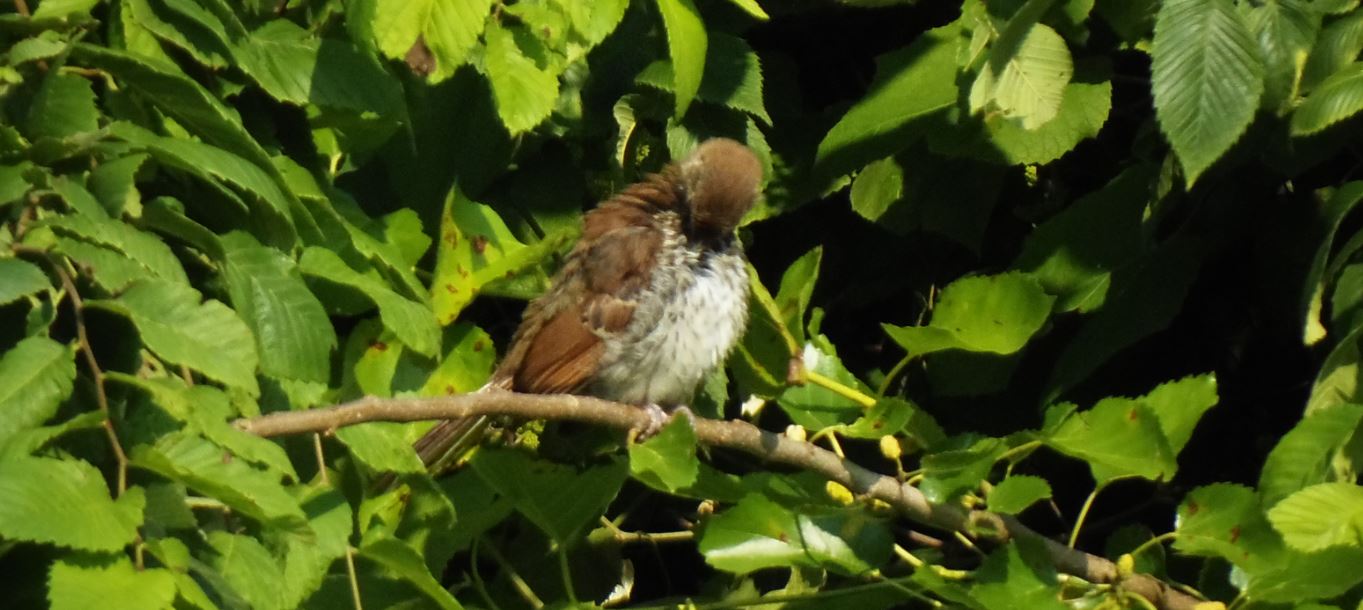
 Yesterday I mentioned two breeding visitors to our area, the Barn Swallow and Cliff Swallow, and today I will discuss yet another, the Brown Thrasher. David was successful recently in snapping some photos so I want to share them with you. He spotted a young thrasher on a branch...
 ...soon joined by a parent, who promptly plopped a mulberry into its mouth.

 Never too young to start good hygiene...


 I'm sure spreading those wings will feel more natural quickly!
The Brown Thrasher is 9 ½ - 11” in length and have a long tail; bright reddish-brown above; two white wingbars; white below, streaked with brown. Their habitat includes open brushy areas, forest edges, hedgerows, thickets, suburbs, parks.

The thrasher, similar to the Mockingbird, is a member of the family Mimidae, or mimic thrushes (the name thrasher derives from the word thrush). A characteristic of this group is the imitation is sounds. The bird is usually seen singing from a high perch out in the open.

Another breeding visitor is the Eastern Kingbird, also pictured below; have seen no young or “parental” activity that I’m aware of.

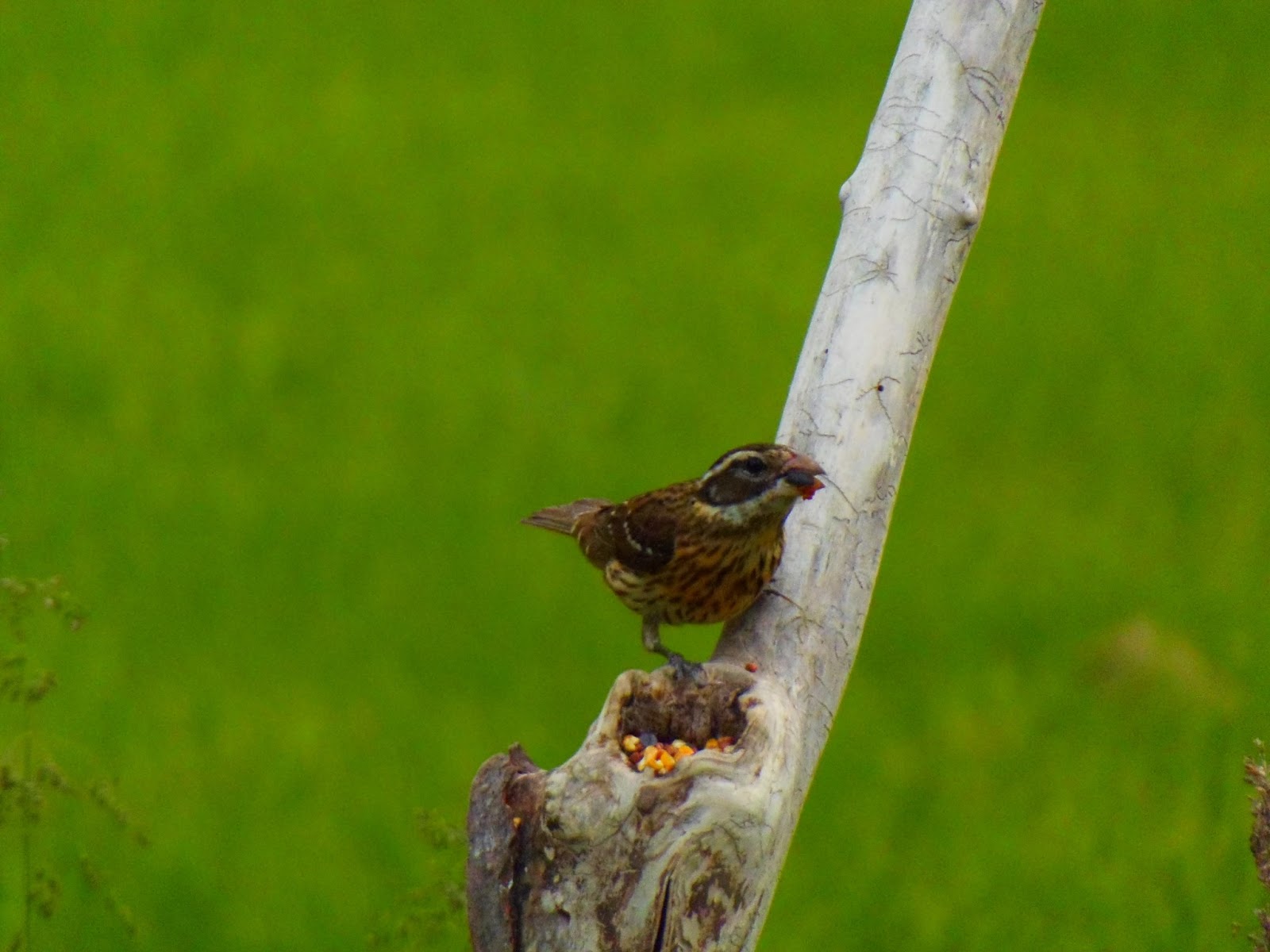
 A visitor to our area is also the Rose-breasted Grosbeak. We are very near the border of being its migratory vs. breeding area, so I am unsure which they are here. We still saw them around May 25th, when David captured them in a few photos (shown below).  As with most things, time will tell.  
The female visits the feeders quite often:


...but the male is shyer and stays by the hedgerows for the most part.

The Indigo Bunting, another breeding visitor, is still gracing us with his presence, but have again seen no young or parenting. The females, with their unremarkable colors and markings of brown and white, can be mistaken for other common birds so I am unsure if there is a pair lurking about or not.
Oh, and that Summer Tanager is still elusive and could learn some manners! Haha Yet another breeding visitor here, but we haven’t seen the yellowish-green female counterpart around. They are mainly insect eaters however, so it isn’t often it is seen near the house.
This time of year is so colorful; in addition to these I've highlighted we also have our year-round residents that add such beauty (woodpeckers, cardinals, blue jays, goldfinches, etc.). The trees appear to have jewels hanging from them as the lights capture their presence on the limbs.

A character we don't get to see very often here is a squirrel, but we recently saw one enjoying the mulberries nearby. I reckon this is a Gray Squirrel; their head and body are 8 - 11" in length, with their tail 8 - 10". They are usually gray on back and sides, whitish below; large, bushy tail. Gray Squirrels breed twice a year, an event accompanied by fights, chases, and other noisy activities. Late winter or spring litters are usually born in tree hollows; summer ones, sometimes in leafy nests out along the branches of a tree. Males play no role in raising the young, which average three per litter and nurse for several months.
 Enjoying a tasty mulberry....
 So good, is reaching for more!
One of our wonders in the world, a sunset must be among them.
 Stop, lift your gaze, 
and watch as the sun gently sets…
let it caress the eyes.
Let it lull the soul into the night... 
and prepare you for evening rest.
Think not of tasks undone,
 think not of tasks for the morrow…
ponder only that which is before you.
The Earth slowly waves goodbye,
ready for its slumber.
(PJ Matthews)
Until next time...