Showing posts with label summer tanager. Show all posts

Tuesday, June 11, 2013

Brown Thrasher and other breeding visitors update

Whoa…in the 90s today and tomorrow, with low temperatures only in the 70s. There’s a slight breeze so it isn’t too awful (in the shade), but it’s a good opportunity to hole up in the house with the A/C going…it needs to be tested anyway. Haha

 Yesterday I mentioned two breeding visitors to our area, the Barn Swallow and Cliff Swallow, and today I will discuss yet another, the Brown Thrasher. David was successful recently in snapping some photos so I want to share them with you. He spotted a young thrasher on a branch...
 ...soon joined by a parent, who promptly plopped a mulberry into its mouth.

 Never too young to start good hygiene...
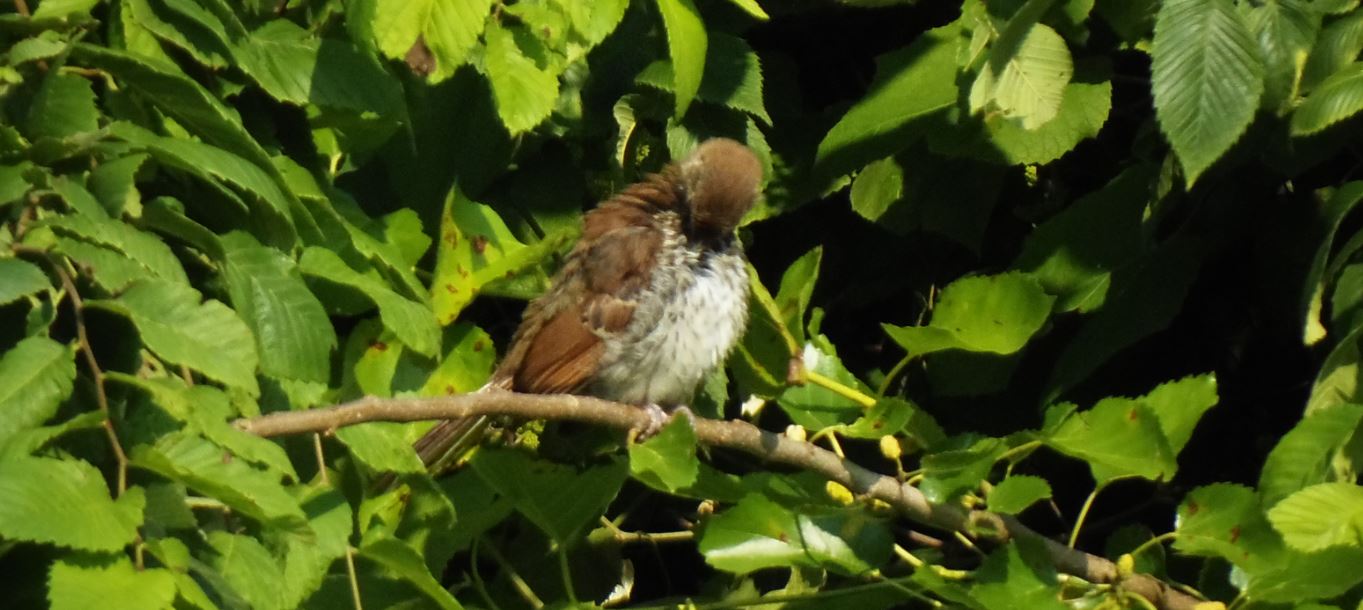


 I'm sure spreading those wings will feel more natural quickly!
The Brown Thrasher is 9 ½ - 11” in length and have a long tail; bright reddish-brown above; two white wingbars; white below, streaked with brown. Their habitat includes open brushy areas, forest edges, hedgerows, thickets, suburbs, parks.

The thrasher, similar to the Mockingbird, is a member of the family Mimidae, or mimic thrushes (the name thrasher derives from the word thrush). A characteristic of this group is the imitation is sounds. The bird is usually seen singing from a high perch out in the open.

Another breeding visitor is the Eastern Kingbird, also pictured below; have seen no young or “parental” activity that I’m aware of.

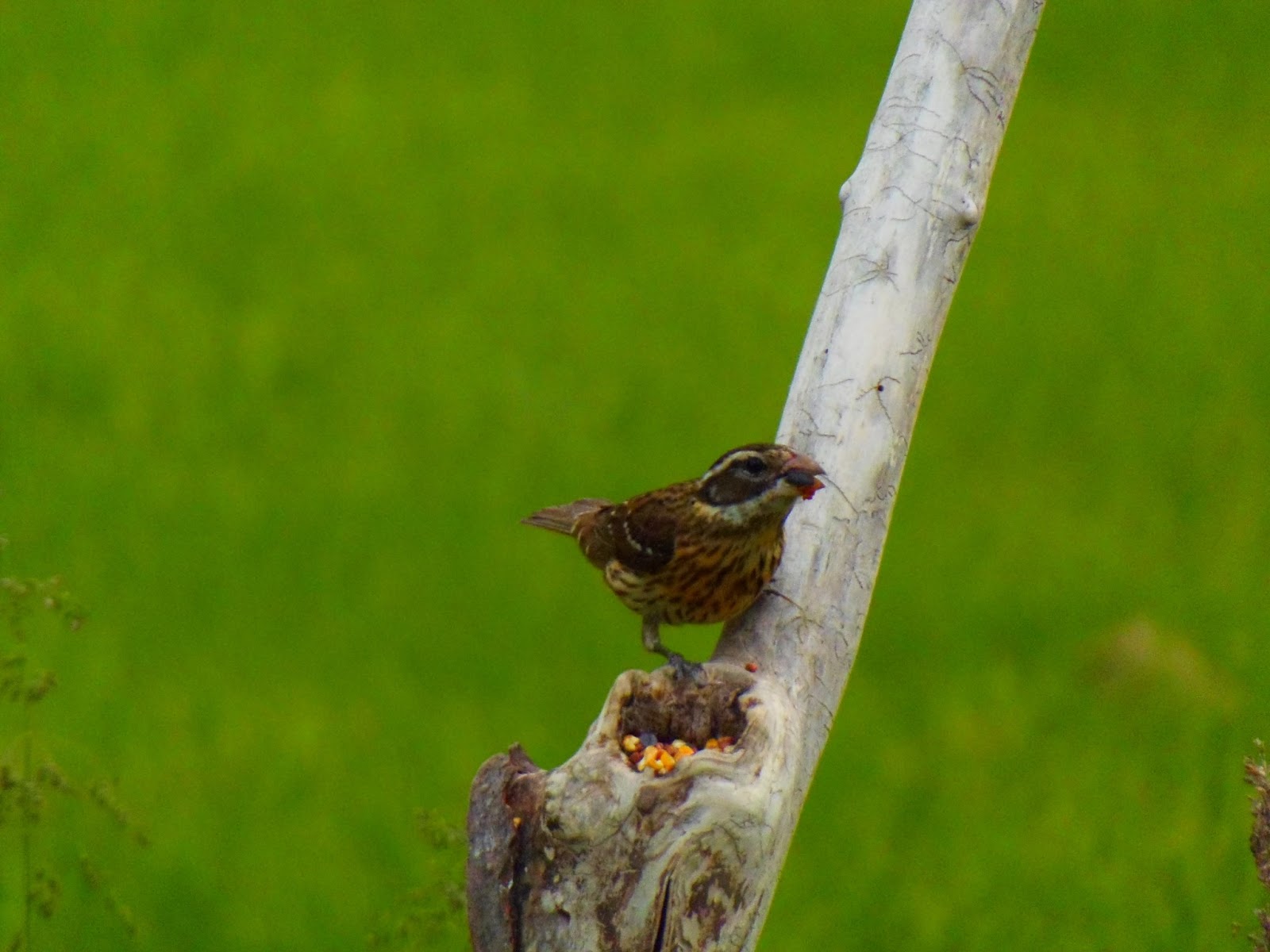
 A visitor to our area is also the Rose-breasted Grosbeak. We are very near the border of being its migratory vs. breeding area, so I am unsure which they are here. We still saw them around May 25th, when David captured them in a few photos (shown below).  As with most things, time will tell.  
The female visits the feeders quite often:


...but the male is shyer and stays by the hedgerows for the most part.

The Indigo Bunting, another breeding visitor, is still gracing us with his presence, but have again seen no young or parenting. The females, with their unremarkable colors and markings of brown and white, can be mistaken for other common birds so I am unsure if there is a pair lurking about or not.
Oh, and that Summer Tanager is still elusive and could learn some manners! Haha Yet another breeding visitor here, but we haven’t seen the yellowish-green female counterpart around. They are mainly insect eaters however, so it isn’t often it is seen near the house.
This time of year is so colorful; in addition to these I've highlighted we also have our year-round residents that add such beauty (woodpeckers, cardinals, blue jays, goldfinches, etc.). The trees appear to have jewels hanging from them as the lights capture their presence on the limbs.

A character we don't get to see very often here is a squirrel, but we recently saw one enjoying the mulberries nearby. I reckon this is a Gray Squirrel; their head and body are 8 - 11" in length, with their tail 8 - 10". They are usually gray on back and sides, whitish below; large, bushy tail. Gray Squirrels breed twice a year, an event accompanied by fights, chases, and other noisy activities. Late winter or spring litters are usually born in tree hollows; summer ones, sometimes in leafy nests out along the branches of a tree. Males play no role in raising the young, which average three per litter and nurse for several months.
 Enjoying a tasty mulberry....
 So good, is reaching for more!
One of our wonders in the world, a sunset must be among them.
 Stop, lift your gaze, 
and watch as the sun gently sets…
let it caress the eyes.
Let it lull the soul into the night... 
and prepare you for evening rest.
Think not of tasks undone,
 think not of tasks for the morrow…
ponder only that which is before you.
The Earth slowly waves goodbye,
ready for its slumber.
(PJ Matthews)
Until next time...

Friday, May 10, 2013

The elusive Summer Tanager

I *think* I saw a Rose-breasted Grosbeak at our feeder over the past few days. They are a migratory bird here so hopefully will be able to snag some photos of it before it's too late. It's so colorful around here!

Another elusive bird that likes to tease us is (possibly) a Summer Tanager, a breeding visitor to our area. David attempted to snap a photo the other day, but the little scamp was nearly out of the bottom frame, but he does resemble the photos from last year (see below):
Last year around May 29th, David was able to get these photos in one of our nearby trees; it certainly fits the Summer Tanager's description. They are 6 - 7 1/2" in length with a yellowish bill; male red; female yellowish green above, yellow below. They enjoy woodlands; in uplands, drier forests of oak, hickory, or pine.

An American Goldfinch is finding its way to one of the new hanging feeders we put up:
 

 An Eastern Bluebird is resting in the nearby Bald Cypress; the bluebird pair have been building a nest in a box we have attached to the trunk. (note: Sadly, we saw an egg that resembles that of a bluebird on the ground today. We admittedly considered attempting to incubate and hatch it, but after reading about the unlikelihood that it is still viable, and the even more unlikely result of providing the correct temperature and its other needs before and after hatching, we had to accept reality.)
A male Cardinal relaxing:
Our Eastern Kingbird is still hanging around our property. Breeding visitors here (they spend their winters in South American forests), they are 7 - 9" in length and are blackish above, white below; dark tail with prominent white band at tip; flies with stiff, shallow wingbeats from a high perch. They enjoy forest edges; woodlands and open areas with some tall trees.
 
Certainly not faint of heart, they are fearless in defense of their territory. It will attack flying from above, pecking and pulling out feathers and may even land on the intruder.

 
Reggie, the Red-headed Woodpecker (and new member of our family) chilling out:
 Our Eastern Phoebe was having quite a preen! They can sure contort themselves:


It's difficult to believe I have written as many posts over the past couple of weeks and have yet to talk about....deer!!! Pope County being the Deer Capital of Illinois, they are definitely abundant around here. While they are seen more around dusk, one must always be alert for them. They are difficult to see at the best of times and can jump out into the road (and in front of you!) very quickly. They're also known to stop just after coming in to the road...the saying "like a deer caught in headlights" was started for a reason!
 
We've seen this young deer alone quite suddenly, however, when it was with about six others recently. It seems fine and healthy, but we haven't seen the others about for a little while.

 
Until next time....