Showing posts with label eastern tiger swallowtail. Show all posts

Sunday, August 4, 2013

The Common Milkweed: Butterflies & The Importance of Going Natural

As I mentioned in another entry previously, we decided to leave areas of our property not mowed so that we could see what grows naturally and its effect on local wildlife. So many "weeds" are quite beneficial and beautiful with flower displays. .

We want to keep our designated areas as natural as possible, identify those plants that seem beneficial, and then add other good sources of food and shelter as we need to, in order to "beautify" and expand the resources for our beloved animals. It's going to be a long process but I am glad we are starting this early so we can gradually attain our final goal of our own private wildlife preserve.

An area by our cess-pond (as I fondly call it) was mowed last year since the entire property was seriously overgrown (the previous owners used it only occasionally as a vacation home), but this year with David leaving it among our "test areas" we recently saw about 30 butterflies of different species engulfing plants with pinkish flowers, a Common Milkweed (Asclepias syriaca).

This native perennial plant is 2 - 6 feet tall (typically 3 - 4 feet tall) and unbranched, except sometimes toward the apex, where the flowers occur. The central stem is relatively stout, pale green, cylindrical and slightly tapered. The opposite leaves are up to 8" long and 3½" wide, broadly oblong in shape, and smooth along their margins. The upper leaf surface is pale-medium to dark green and hairless above, while the lower leaf surface is densely covered with woolly hairs that are very short. There is a prominent central vein along the length of each leaf, and finer side veins that radiate outward toward the smooth margins.

Umbels of flowers, each about 2½" - 4" across, emerge from the axils of the upper leaves. These flowers are quite fragrant, with a scent resembling violets or pansies, and they range in color from faded light pink to reddish purple. Each flower is about ¼" across, star-shaped in dense rounded clusters at top of straight stem. The hoods are more light-colored than the petals. The pedicels of the flowers are light green to pale red and hairy. The blooming period lasts about 1 - 1½ months from early to mid-summer (June, July, August). The seedpods (follicles) are 3" - 4" long and covered with soft prickles and short woolly hairs. At maturity, each seedpod split along one side to release numerous seeds that have large tufts of white hair, with dispersion of seed by wind. The root system has long creeping rhizomes, promoting the vegetative spread.

Common Milkweed occurs in every county of Illinois and it is quite common. Habitats include moist to dry black soil prairies, sand prairies, sand dunes along lake shores, thickets, woodland borders, fields and pastures, abandoned fields, vacant lots, fence rows, and areas along railroads and roadsides. This plant is a colonizer of disturbed areas in both natural and developed habitats.

The crown-like flowers of milkweeds are cunning traps for insect pollinators, second in their intricacy only to the orchids. Each blossom has five nectar cups with smooth, incurved horns growing from them. When an insect lands, its foot slips on a horn and goes into a slit between two cups. If the insect is not strong enough to pull its legs out, it dies there (or is eaten by another). If it is strong enough, it comes away carrying two bags of pollen, called pollinia, like saddlebags. At the next flower, its foot slips again; this time, as it picks up more pollinia, it deposits the first two beside the cups, where the pollen develops to fertilize future seeds.

When either the central stem or leaves are torn, a milky sap oozes out that has variable toxicity in the form of cardiac glycosides. The name milkweed refers to the milky white  sap, which contains bitter chemicals to protect the plants from predators. A few insects are immune to these poisons and accumulate them in their bodies, protecting themselves from their own predators. Monarch butterflies cannot complete their life cycles without milkweed. 

There is a legend of the Old West about a runty outlaw who drank rattlesnake venom every morning so he could kill a big man by spitting in his eye. Milkweeds furnish similar venom for Monarch butterflies. The leaves are poisonous to most animals, but Monarch caterpillars and a few others eat nothing else. As a result, they - and the butterflies they become - are themselves toxic to potential predators. The Viceroy butterfly benefits by its resemblance to the Monarch; predators tend to leave them alone. This is known as mimicry and is also true for other species as well, such as the Pipevine Swallowtail.
 
~~~~~~~~~~~~~~~~~~~~~~~~~~~~~~~~~~~~~~~~~~~~~~~~~~~~~~
And believe it or not, the milkweed can be used as food for human consumption, but please first note: Warning: ***Poisonous Parts***: Milky sap from leaves, stems (toxic only in large quantities). Symptoms include vomiting, stupor, weakness, spasms by ingesting other species; need careful identification.   

Edible Parts:  Leaves, new shoots, flower buds and firm seed pods. Gather leaves in early spring when they first open. Gather seed pods in summer. Parboil for three minutes, then discard bitter water and replace with clean boiling water. (Cold water tends to fix bitterness.) Repeat this process three times, then cook the leaves for 15 minutes before seasoning them. A pinch of soda can be added during cooking to break down the fiber and improve flavor.

The young shoots under six inches long, found during the spring are used as a vegetable. Remove the fuzz on the shoot by rubbing it off. Preparation is the same as for the leaves. Collect flower buds and flowers during the summer. Dip buds in boiling water for one minute, batter and deep fry. When cooked like broccoli, buds are similar to okra. The flower clusters may also be battered and fried. After cooking, buds, flowers and leaves can be frozen. Use like okra in soups. A bit of baking soda in the water will help break down the tough fibers in the seed pod. Parboiled for several minutes, the young pods may be slit, rolled in a cornmeal/flour mixture and fried or frozen for future use.
~~~~~~~~~~~~~~~~~~~~~~~~~~~~~~~~~~~~~~~~~~~~~~~~~~~~~
 
Whether it's as a food source, shelter, or as a balance with other plant life, so much of our wildlife depends on them! When I was a kid walking the soybean and corn fields on my dad's farm, though, this was one of the plants I detested trying to get out the most! They seemed impossible to cut or pull and it usually ended up with my brother-in-law forced to cross over row upon row of crop to help me. Hey, I was only a little kid! haha That sap was no fun when it got on you either! 
As for the butterflies that David photographed on the milkweeds, I will be posting separately about them so that I can provide some (hopefully) interesting facts about each. I can't believe the massive butterflies around here, I can see them halfway across the property! The eastern tiger swallowtail, spicebush swallowtail, and great spangled fritillary (to name a few) certainly add to the colorful beauty around our home, and deserve their own featured entries.

And for a quick update on our "pet" birds, we haven't seen bluejays or cowbirds for quite a while, and this was true last year as well. We are seeing more cardinals and their young, many goldfinches and indigo buntings (which I am very happy about!). The goldfinches and buntings are in the "weed" patches often, and those natural areas appear to have attracted greater numbers of them. The hummingbird charm (who also like milkweed by the way!) is in full force and going through our sugar like crazy. Our summer thus far has been hot but with some cooler temps mixed in, and lovely rains that we missed out on last year during our drought. It's just about 80F today and sunny, another gorgeous day in the Shawnee Forest.

Until next time...


Tuesday, April 23, 2013

Birdfood wars & why did the Killdeer cross the road?

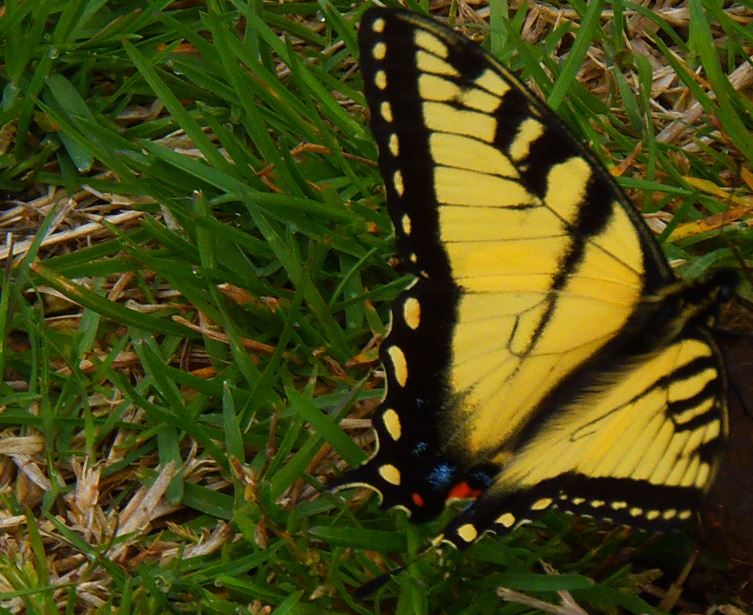
David snapped some photos on April 17th that I want to share today. First, I'll feature the Eastern Tiger Swallowtail (a Fluted Swallowtail) that he happened upon. This species has a 2 1/2 - 6 1/2" wingspan. They are a large butterfly, unusually dark, with pale to bright yellow spots near edge of wings and usually has a tail. They enjoy deserts, grasslands, forests and gardens.


Here we have more photos of the Killdeer I featured yesterday. You can read more about these birds (as all others featured on this blog) by clicking on the Birds tab at the top. I wanted to share with you now an interesting tidbit about these birds, though, is their defense if a predator comes very near their eggs or young: they will try to lure it away by playing wounded. With one wing held up over the back and the other flapping on the ground, it waits for the intruder to get close, then runs and repeats the display until the intruder is a safe distance from the nest or young.
 
 It's not only chickens that cross the road!


Everything here is so different than where I grew up and every day here is an adventure, whether it's just walking down to the mailbox...or watching the feeders, especially when there are several varieties wanting to eat! On this particular photo session, we had cardinals, goldfinch, white-throated sparrow and chipping sparrow trying to see who would win the birdfood-wars.
(Above) In front, Chipping Sparrow, middle American Goldfinch, in back is White-throated Sparrow.
 
(Below) At left, below feeder, and at far left on feeder, female Cardinals; next American Goldfinch (showing back still molting for Spring); at back is White-throated Sparrow).

 (Below, the male Cardinal joins an American Goldfinch (bright yellow) and two White-throated Sparrows)
 Cardinals do love their sunflower seeds....


Oops, not on the feeder, but can't resist photos of the Holly bush! Distractions, as I said, are the norm around here :)
Back to the feeder:


 What's a day without a Ruby-throated Hummingbird fix?!? As of this date, we have two males and a female!