Showing posts with label deer. Show all posts

Sunday, November 3, 2013

Common Flicker, Woolly Bear Caterpillar, and Deer (of course)

It's amazing how time can fly...my last post was August 4th!?!? I guess that shouldn't surprise me...we were still waiting for David to see the doctors at Barnes Jewish Hospital in St. Louis, MO to see if they could rid him of the infection and fix his shoulder. Mentally, we were both finished by then; the good news, however, is that the doctors there were able to repair the problems better than we dreamed.

He still has a long road ahead of him, but it does seem the infection is finally subsiding (he had to have a catheter PICC line with IV antibiotics for just under six weeks and he has to take oral antibiotics for some time yet) and the orthopedic surgeon pretty much un-did what the original doctor did and a lot of "fixing up". We're still in shock that this nightmare that we've endured for this entire year may be coming to an end.

He's been very busy trying to get his workshop going now (that we bought shortly before he tore his shoulder last year!) and with the massive restoration needed, this has taken all our energy and then some (on top of David's physical therapy as well). Is life back to "normal"? No...but we don't really have a "normal" so we just take each day as it comes. He hasn't been able to take photos much as of yet, his arm and back tire very easily and he gets very sore, but he does what he can.
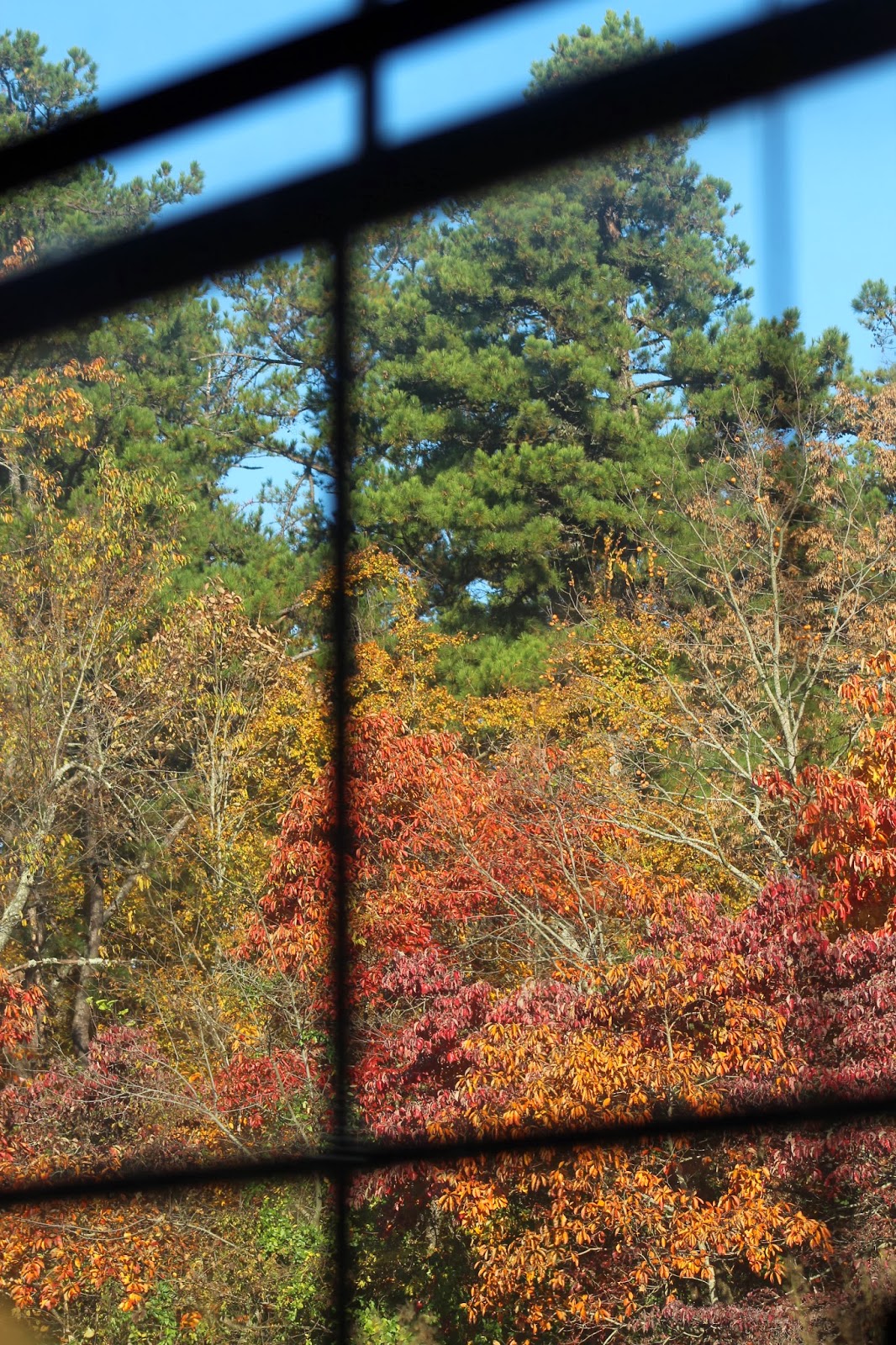
We're seeing the gorgeous fall colors of our trees now; the various deciduous trees emblazon the sky with their copious shades of yellows, oranges and reds, the fruit trees laid mostly bare with the recent rains ripping away what leaves were still hanging tenuously from the branches, and intermingled are the stately pines with their green needles a constant reminder of life, and the holly tree announcing a robust crop of berries just in time for winter. What a joy to see!

Today unfolded with a rather strange morning...there I was, sitting in my recliner, sipping my coffee and looking out my living room window, as usual...
...when David opened the front door and exclaimed, "Come look at the mist!". Sure enough, while I was looking at a perfectly clear north side of the house (above), the south side looked like this (below)...
and the east side was like this...
Crazy.  

We're seeing the blue jays again, and juncos, and hearing our friendly neighborhood woodpeckers. Today, David was able to capture the Common Flicker (the yellow-shafted race) that we have never seen before, although they are year-round residents of our area.
 They are 10 - 13 inches in length, with a wingspan of 18 to 21 inches. Weights range from 4 to 6 ounces. There is a red chevron on the back of its head; white rump; black crescent at throat; yellow or red on underside of wings and tail (in the East, yellow only); male with "moustache" of black (in the East, the yellow-shafted race) or red (West, the red-shafted race). Their habitats are deserts, farmlands, suburbs, parks, and open forests.
 In the photo below, the Common Flicker is in the lower right...so pretty in flight, you can just see the hint of yellow. I hope to have many more photos to share of this beauty.
 This woodpecker, unlike most other woodpecker species, is often seen on the ground, searching for ants and licking them up with its long tongue; they also eat termites, caterpillars, crickets, and grasshoppers, but will come to feeders for seeds and suet. It nests in holes in trees (or substitutes such as telephone poles). Both sexes excavate a cavity from 10 to 90 feet up, unless natural cavities are available.  From 3 to 12 white eggs, incubated by both parents, hatch in about 12 days. Both parents care for the young, who leave the nest in just under a month. Flickers are conspicuous in the Fall, when they often travel in loose flocks.
David also snapped 168 photos of a caterpillar today! haha It turned out to be the Woolly Bear, which turns into the Isabella tiger moth. A common sight on our roads, David now humors me and swerves as safely as possible to avoid running over them. I do admit, they are difficult to see, so I try and scout for him and tell him where to weave. As a kid, I always just knew these as woolly worms, and of course heard the folklore that the length of the black bands foretold the severity of the upcoming winter. Apparently, though, it merely determines the age. Another childhood tale dashed!
(from Wikipedia): The Isabella Tiger Moth (Pyrrharctia isabella) can be found in many cold regions, including the Arctic. The banded Woolly Bear larva emerges from the egg in the fall and overwinters in its caterpillar form, when it literally freezes solid. First its heart stops beating, then its gut freezes, then its blood, followed by the rest of the body. It survives being frozen by producing a cryoprotectant in its tissues. In the spring it thaws out and emerges to pupate. Once it emerges from its pupa as a moth it has only days to find a mate.
 
Caterpillar hosts are: asters, birches, clover, corn, elms, maples, and sunflowers.
 
In case you ever wanted to see the facial profile of a woolly worm, see the photo below.
This time of year also brings many hunters to our area (since Pope County is the deer capital of Illinois)...the deer are noticeably absent, they surely know the hunters are around! David was still able to find one sneaking about though.

I had better stop for today...I keep rambling on! Apologies for the long absence yet again...this time, hopefully, I can get back to enjoying life around here again and actually documenting some of it!
 
Until next time....

Sunday, June 9, 2013

Eastern Bluebirds and their young

Dear Diary,

I have missed writing! Now that the month of May-hem is over, perhaps life can resume to its normal trials and tribulations instead of piling more on one day after the next! Now that the well is back in working order (for the second time, due to the cable shorting out...unrelated to the work done the first time), and attempts to catch up are gradually succeeding, I can get back to writing in our diary.
 
First, an apology to my husband…for being a jinx! On May 10th, I mentioned in my last “normal post” about deer in our area and being careful while driving; on May 28th, he hit a deer! Correction, a deer hit him. He is always very cautious but this was an example that sometimes it doesn’t matter. As he was driving home from just a few miles away, he was driving past the guardrail by the river when he became conscious of something in the side mirror; in that split second, a deer hit the left headlight/turn signal and then David heard a second thud beside him (which was the driver's door being dented!). The deer was apparently in the deep bank and lunged for the road; being impossible to see since David had actually already driven past him until he saw him as it struck the vehicle. 

David feared it may be hurt and suffering, so went back and saw the deer scramble to its feet and leap into the woods. Pfffft, not even any venison to reward us after that nonsense! As it turned out, after the deer hit the front, he must have been spun around and he hit the driver’s side door and David was unable to open the door. He had to crawl into the passenger side and crawl over….which is very tricky with his recovering shoulder. 

So, actually, I owe my husband two apologies…the second apology being that when he off-handedly mentioned driving down to the river as the light of day was fading, I laughingly said, “after the May we’ve had, I wouldn’t”. I should have known better! Jinx!
 
But all was not doom and gloom during the merry month of May. One of our favorite things, bird-watching, was rewarded last month with our Eastern Bluebirds. The bluebird parents were very busy as they both perched in various areas throughout the yard to catch insects in order to feed their young. One would perch on a nearby tree while another would perch on a wire farther down the property, swoop down and fly to the nest to feed; once done the other would fly to the nest and feed as well. A great example of teamwork!
 
 
They would then change positions, sometimes also on top of the flagpole and at times in other trees, ever watchful for insects to catch. This would go on for hours, every day, in the mornings and evenings. It was difficult to keep track of them and their seemingly endless hunting.
 
 
As each would catch food, they would fly over to the nest and stick their heads in to feed the young awaiting their next morsel eagerly.
 
Then we were able to see the young peeking out of the nest! What a shock it must be for the young ones to look out of their small wooden box to see the big wide world out there!
  
 
The parents would still do their cycle of watching, swooping, grabbing, and flying to the nest to feed their young. It was an amazing thing to see and I am so glad the bluebirds decided to nest in a tree we could see easily from our front deck.

Wait...don't go...I'm still hungry!


A week or so ago, the bluebird parents began flying around together from tree to tree, chattering between themselves often. Fledglings remain dependent on their parents for about a month, so we hoped we would have time to see it/them. We kept watch on the nest but could see no young looking out, so we are assuming the fledglings were being taught by their parents on how to be an Eastern Bluebird. As hard as we tried, we could not see it/them even though they were bound to be nearby and still talking with each other often, discussing their young.
 
Until a few days ago that is! Around 8:30, David saw the bluebirds flying about and I joined him on the deck. The two bluebirds were showing the young’un the ropes and it was so adorable. One of them was on top of the flagpole, when I saw the young’un fly from the tree and fly toward the flagpole. It suddenly seemed unsure how to land with another bird there, so it flew past and then became confused of where to go next! It floundered during flight for a bit but then swooped up to the roof to get its bearings. The parent flew off toward the cypress tree and the young followed. It was such a joy to see them out and about, ready to begin another cycle of life.
 
We wish our lovely new family the very best!

We haven’t seen much of our hummingbird charm of late…since there is an abundance of honeysuckle (our air is redolent of it!) and other tasty items we’re hoping they are merely taking advantage of their availability. I did see one come to the feeder last night for a brief sip. We didn’t want to use our tap water since it still tasted of the chlorination treatment required when the well was repaired, and used rain water. We then considered what if they don’t like rain water either? David tested by changing one of them to bottled water and within minutes, a hummingbird flew to it and drank. I've been seeing more visits to the feeder, so I guess that settles that! It’s amazing that they can tell without actually tasting it, even if the water is boiled. 

Until next time....


Friday, May 10, 2013

The elusive Summer Tanager

I *think* I saw a Rose-breasted Grosbeak at our feeder over the past few days. They are a migratory bird here so hopefully will be able to snag some photos of it before it's too late. It's so colorful around here!

Another elusive bird that likes to tease us is (possibly) a Summer Tanager, a breeding visitor to our area. David attempted to snap a photo the other day, but the little scamp was nearly out of the bottom frame, but he does resemble the photos from last year (see below):
Last year around May 29th, David was able to get these photos in one of our nearby trees; it certainly fits the Summer Tanager's description. They are 6 - 7 1/2" in length with a yellowish bill; male red; female yellowish green above, yellow below. They enjoy woodlands; in uplands, drier forests of oak, hickory, or pine.

An American Goldfinch is finding its way to one of the new hanging feeders we put up:
 

 An Eastern Bluebird is resting in the nearby Bald Cypress; the bluebird pair have been building a nest in a box we have attached to the trunk. (note: Sadly, we saw an egg that resembles that of a bluebird on the ground today. We admittedly considered attempting to incubate and hatch it, but after reading about the unlikelihood that it is still viable, and the even more unlikely result of providing the correct temperature and its other needs before and after hatching, we had to accept reality.)
A male Cardinal relaxing:
Our Eastern Kingbird is still hanging around our property. Breeding visitors here (they spend their winters in South American forests), they are 7 - 9" in length and are blackish above, white below; dark tail with prominent white band at tip; flies with stiff, shallow wingbeats from a high perch. They enjoy forest edges; woodlands and open areas with some tall trees.
 
Certainly not faint of heart, they are fearless in defense of their territory. It will attack flying from above, pecking and pulling out feathers and may even land on the intruder.

 
Reggie, the Red-headed Woodpecker (and new member of our family) chilling out:
 Our Eastern Phoebe was having quite a preen! They can sure contort themselves:


It's difficult to believe I have written as many posts over the past couple of weeks and have yet to talk about....deer!!! Pope County being the Deer Capital of Illinois, they are definitely abundant around here. While they are seen more around dusk, one must always be alert for them. They are difficult to see at the best of times and can jump out into the road (and in front of you!) very quickly. They're also known to stop just after coming in to the road...the saying "like a deer caught in headlights" was started for a reason!
 
We've seen this young deer alone quite suddenly, however, when it was with about six others recently. It seems fine and healthy, but we haven't seen the others about for a little while.

 
Until next time....