Showing posts with label feeding young. Show all posts

Tuesday, June 11, 2013

Brown Thrasher and other breeding visitors update

Whoa…in the 90s today and tomorrow, with low temperatures only in the 70s. There’s a slight breeze so it isn’t too awful (in the shade), but it’s a good opportunity to hole up in the house with the A/C going…it needs to be tested anyway. Haha

 Yesterday I mentioned two breeding visitors to our area, the Barn Swallow and Cliff Swallow, and today I will discuss yet another, the Brown Thrasher. David was successful recently in snapping some photos so I want to share them with you. He spotted a young thrasher on a branch...
 ...soon joined by a parent, who promptly plopped a mulberry into its mouth.

 Never too young to start good hygiene...
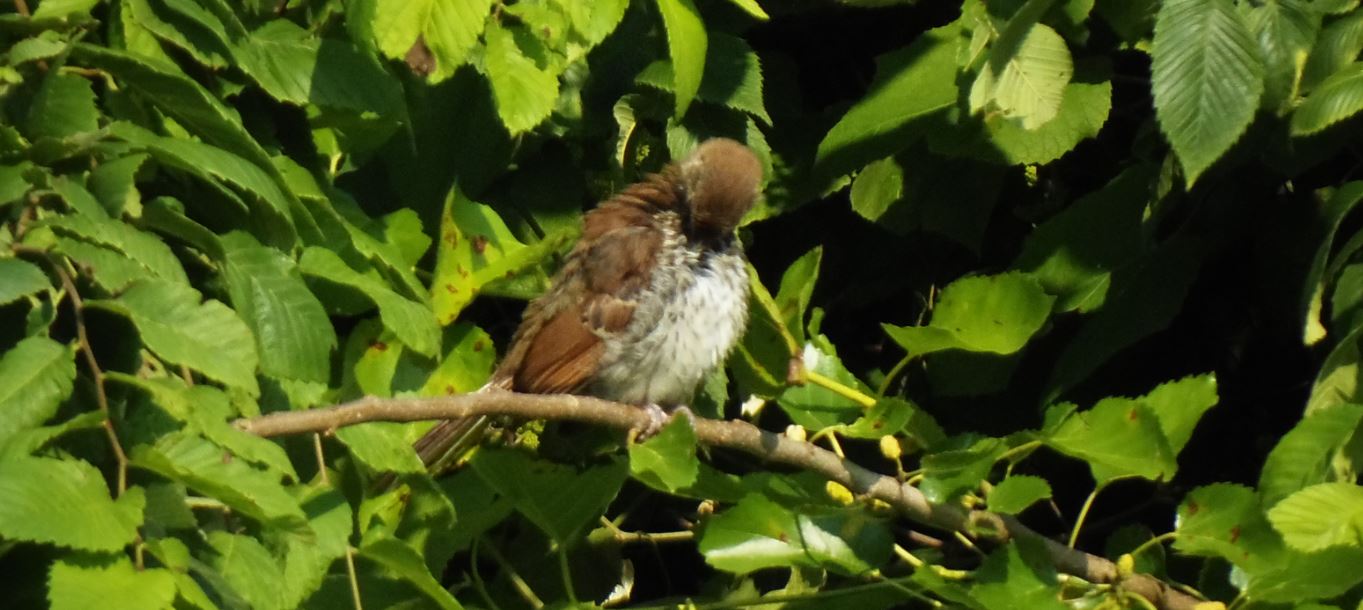


 I'm sure spreading those wings will feel more natural quickly!
The Brown Thrasher is 9 ½ - 11” in length and have a long tail; bright reddish-brown above; two white wingbars; white below, streaked with brown. Their habitat includes open brushy areas, forest edges, hedgerows, thickets, suburbs, parks.

The thrasher, similar to the Mockingbird, is a member of the family Mimidae, or mimic thrushes (the name thrasher derives from the word thrush). A characteristic of this group is the imitation is sounds. The bird is usually seen singing from a high perch out in the open.

Another breeding visitor is the Eastern Kingbird, also pictured below; have seen no young or “parental” activity that I’m aware of.

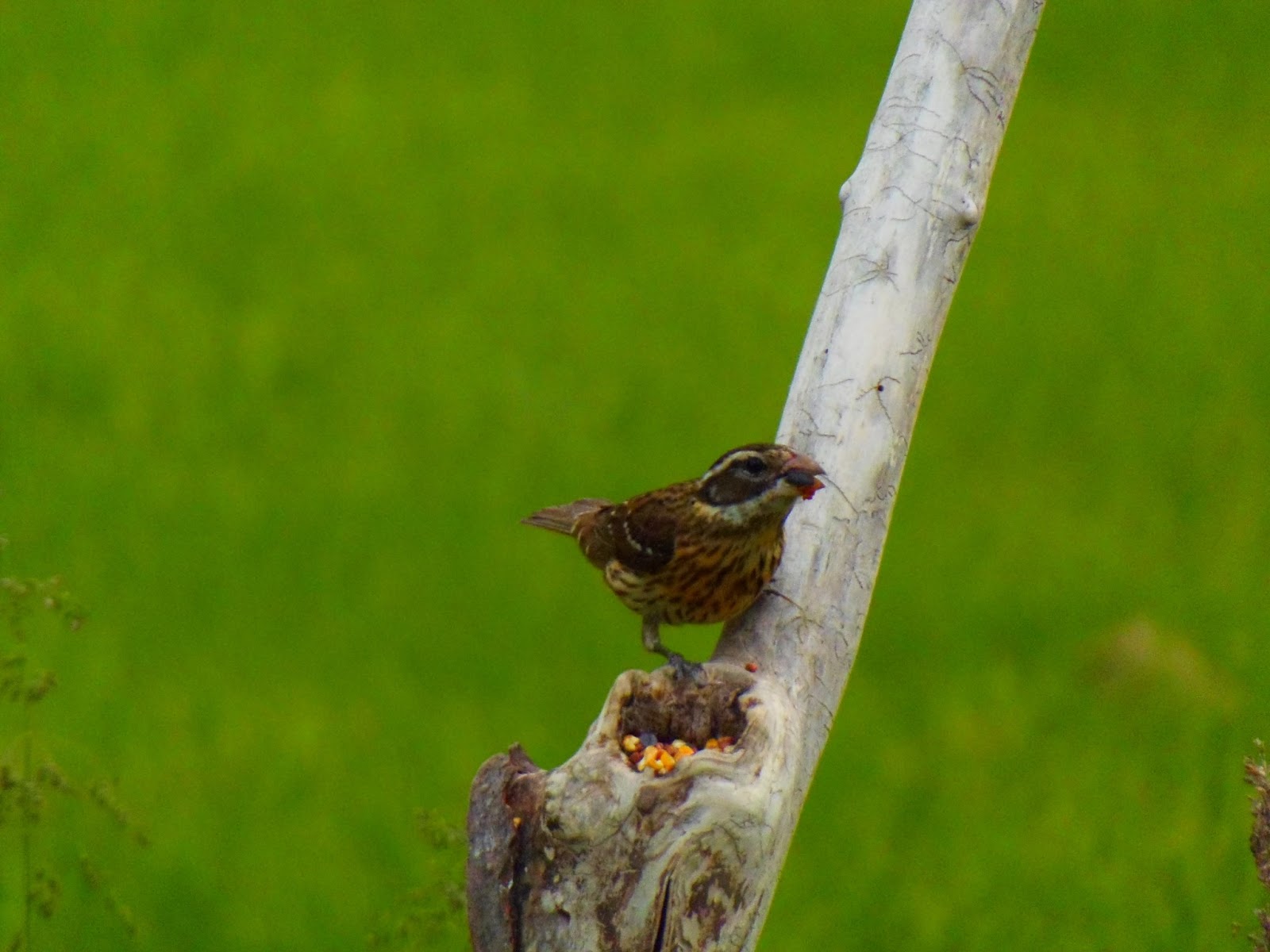
 A visitor to our area is also the Rose-breasted Grosbeak. We are very near the border of being its migratory vs. breeding area, so I am unsure which they are here. We still saw them around May 25th, when David captured them in a few photos (shown below).  As with most things, time will tell.  
The female visits the feeders quite often:


...but the male is shyer and stays by the hedgerows for the most part.

The Indigo Bunting, another breeding visitor, is still gracing us with his presence, but have again seen no young or parenting. The females, with their unremarkable colors and markings of brown and white, can be mistaken for other common birds so I am unsure if there is a pair lurking about or not.
Oh, and that Summer Tanager is still elusive and could learn some manners! Haha Yet another breeding visitor here, but we haven’t seen the yellowish-green female counterpart around. They are mainly insect eaters however, so it isn’t often it is seen near the house.
This time of year is so colorful; in addition to these I've highlighted we also have our year-round residents that add such beauty (woodpeckers, cardinals, blue jays, goldfinches, etc.). The trees appear to have jewels hanging from them as the lights capture their presence on the limbs.

A character we don't get to see very often here is a squirrel, but we recently saw one enjoying the mulberries nearby. I reckon this is a Gray Squirrel; their head and body are 8 - 11" in length, with their tail 8 - 10". They are usually gray on back and sides, whitish below; large, bushy tail. Gray Squirrels breed twice a year, an event accompanied by fights, chases, and other noisy activities. Late winter or spring litters are usually born in tree hollows; summer ones, sometimes in leafy nests out along the branches of a tree. Males play no role in raising the young, which average three per litter and nurse for several months.
 Enjoying a tasty mulberry....
 So good, is reaching for more!
One of our wonders in the world, a sunset must be among them.
 Stop, lift your gaze, 
and watch as the sun gently sets…
let it caress the eyes.
Let it lull the soul into the night... 
and prepare you for evening rest.
Think not of tasks undone,
 think not of tasks for the morrow…
ponder only that which is before you.
The Earth slowly waves goodbye,
ready for its slumber.
(PJ Matthews)
Until next time...

Sunday, June 9, 2013

Eastern Bluebirds and their young

Dear Diary,

I have missed writing! Now that the month of May-hem is over, perhaps life can resume to its normal trials and tribulations instead of piling more on one day after the next! Now that the well is back in working order (for the second time, due to the cable shorting out...unrelated to the work done the first time), and attempts to catch up are gradually succeeding, I can get back to writing in our diary.
 
First, an apology to my husband…for being a jinx! On May 10th, I mentioned in my last “normal post” about deer in our area and being careful while driving; on May 28th, he hit a deer! Correction, a deer hit him. He is always very cautious but this was an example that sometimes it doesn’t matter. As he was driving home from just a few miles away, he was driving past the guardrail by the river when he became conscious of something in the side mirror; in that split second, a deer hit the left headlight/turn signal and then David heard a second thud beside him (which was the driver's door being dented!). The deer was apparently in the deep bank and lunged for the road; being impossible to see since David had actually already driven past him until he saw him as it struck the vehicle. 

David feared it may be hurt and suffering, so went back and saw the deer scramble to its feet and leap into the woods. Pfffft, not even any venison to reward us after that nonsense! As it turned out, after the deer hit the front, he must have been spun around and he hit the driver’s side door and David was unable to open the door. He had to crawl into the passenger side and crawl over….which is very tricky with his recovering shoulder. 

So, actually, I owe my husband two apologies…the second apology being that when he off-handedly mentioned driving down to the river as the light of day was fading, I laughingly said, “after the May we’ve had, I wouldn’t”. I should have known better! Jinx!
 
But all was not doom and gloom during the merry month of May. One of our favorite things, bird-watching, was rewarded last month with our Eastern Bluebirds. The bluebird parents were very busy as they both perched in various areas throughout the yard to catch insects in order to feed their young. One would perch on a nearby tree while another would perch on a wire farther down the property, swoop down and fly to the nest to feed; once done the other would fly to the nest and feed as well. A great example of teamwork!
 
 
They would then change positions, sometimes also on top of the flagpole and at times in other trees, ever watchful for insects to catch. This would go on for hours, every day, in the mornings and evenings. It was difficult to keep track of them and their seemingly endless hunting.
 
 
As each would catch food, they would fly over to the nest and stick their heads in to feed the young awaiting their next morsel eagerly.
 
Then we were able to see the young peeking out of the nest! What a shock it must be for the young ones to look out of their small wooden box to see the big wide world out there!
  
 
The parents would still do their cycle of watching, swooping, grabbing, and flying to the nest to feed their young. It was an amazing thing to see and I am so glad the bluebirds decided to nest in a tree we could see easily from our front deck.

Wait...don't go...I'm still hungry!


A week or so ago, the bluebird parents began flying around together from tree to tree, chattering between themselves often. Fledglings remain dependent on their parents for about a month, so we hoped we would have time to see it/them. We kept watch on the nest but could see no young looking out, so we are assuming the fledglings were being taught by their parents on how to be an Eastern Bluebird. As hard as we tried, we could not see it/them even though they were bound to be nearby and still talking with each other often, discussing their young.
 
Until a few days ago that is! Around 8:30, David saw the bluebirds flying about and I joined him on the deck. The two bluebirds were showing the young’un the ropes and it was so adorable. One of them was on top of the flagpole, when I saw the young’un fly from the tree and fly toward the flagpole. It suddenly seemed unsure how to land with another bird there, so it flew past and then became confused of where to go next! It floundered during flight for a bit but then swooped up to the roof to get its bearings. The parent flew off toward the cypress tree and the young followed. It was such a joy to see them out and about, ready to begin another cycle of life.
 
We wish our lovely new family the very best!

We haven’t seen much of our hummingbird charm of late…since there is an abundance of honeysuckle (our air is redolent of it!) and other tasty items we’re hoping they are merely taking advantage of their availability. I did see one come to the feeder last night for a brief sip. We didn’t want to use our tap water since it still tasted of the chlorination treatment required when the well was repaired, and used rain water. We then considered what if they don’t like rain water either? David tested by changing one of them to bottled water and within minutes, a hummingbird flew to it and drank. I've been seeing more visits to the feeder, so I guess that settles that! It’s amazing that they can tell without actually tasting it, even if the water is boiled. 

Until next time....